
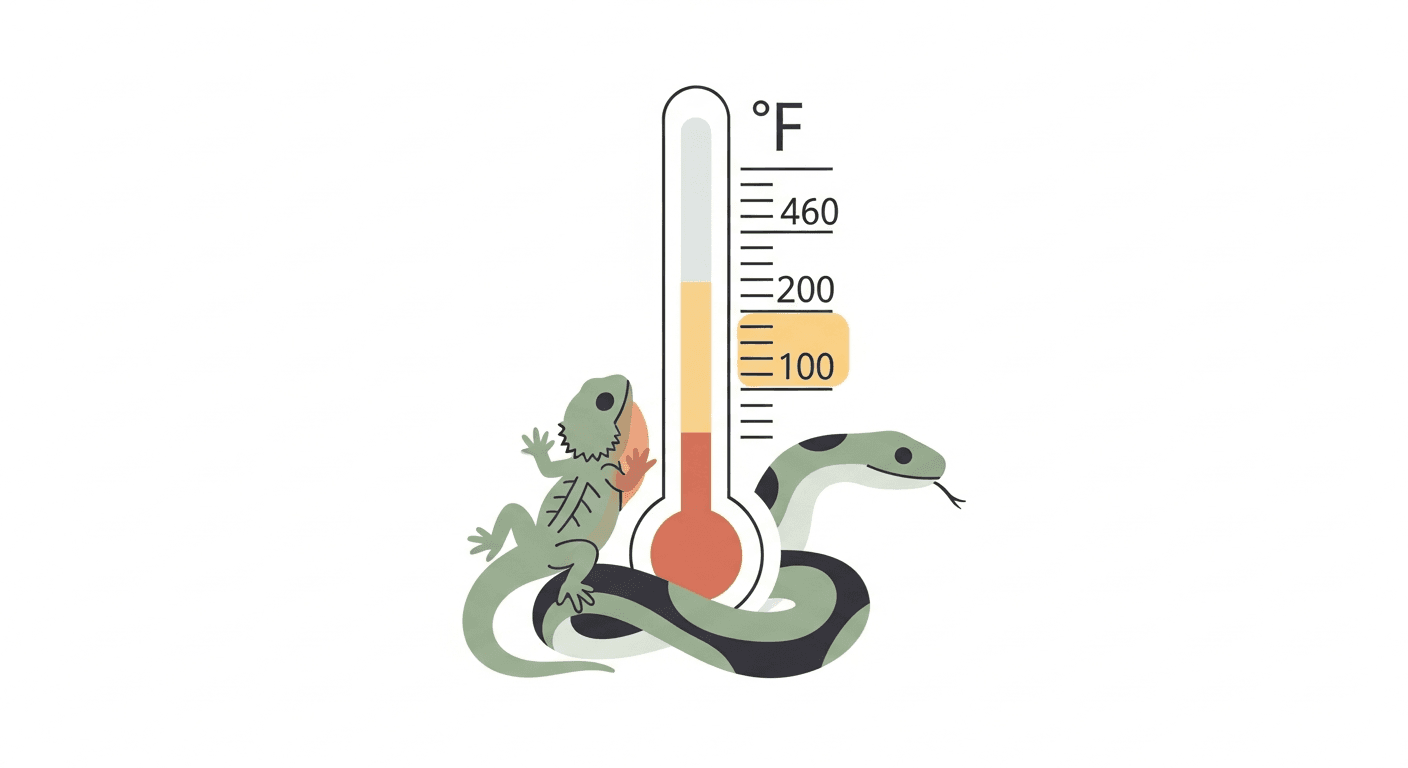
Why Temperature Is the Foundation of Reptile Health
Reptiles are ectotherms — they rely on environmental heat to regulate their body temperature. Unlike mammals, they cannot generate internal body heat through metabolism. This means that nearly every physiological process — digestion, immune function, wound healing, reproduction — depends on the reptile having access to appropriate temperatures. A reptile kept too cold does not "slow down safely"; it develops suppressed immunity, fails to digest food, and becomes vulnerable to bacterial and viral infections that a healthy-temperature animal would fight off easily.
Temperature problems are the single most common underlying cause of illness in captive reptiles.
First 3 Steps at Home
- Verify temperatures with accurate instruments: Strip thermometers are unreliable — they measure air temperature near where they are stuck, not the surface temperature where the reptile actually sits. Use an infrared temperature gun for surface (basking spot) temperatures and a probe thermometer for ambient air temperatures. Measure at multiple points: basking surface, warm end ambient, cool end ambient, and nighttime low.
- Create a true thermal gradient: Every enclosure needs a warm end and a cool end. The reptile moves between these to regulate its body temperature. An enclosure that is uniformly heated at the correct average removes this ability and causes chronic thermal stress. The temperature difference between the warm end and cool end should be significant — for a bearded dragon, basking 42°C versus cool end 26°C.
- Check nighttime temperatures: Many species tolerate or benefit from nighttime temperature drops, but all have minimum safe nighttime temperatures. Ball pythons should not drop below 24°C at night. Bearded dragons should not drop below 18–20°C. If your room cools significantly at night in winter, a ceramic heat emitter (which produces heat without light) may be needed to maintain safe overnight temperatures.
When to Go to the Vet Immediately
- Any reptile that has been exposed to dangerously low temperatures for an extended period — hypothermia can cause permanent organ damage
- Respiratory signs developing after a cold exposure
- Regurgitation of recently eaten prey — often caused by temperatures too low for digestion
- Sudden lethargy in a reptile whose temperatures have been confirmed correct — systemic illness
Follow-Up Care Checklist
- Check temperatures every morning as part of the care routine
- Replace heat bulbs when they burn out immediately — do not leave the animal without heat
- Use a thermostat for all heating equipment to prevent overheating — unthermostated ceramic heaters have killed animals by overheating
- Have a backup heating plan for power outages if you live in a cold climate
Track Temperature Daily with TailRounds
Log morning temperature readings in the TailRounds Daily Log. A temperature log that shows a gradual decline over weeks (perhaps as a bulb weakens) can explain a concurrent health change that would otherwise seem mysterious.
Book a Vet Appointment
If you're unsure whether your setup is correct for your species, a reptile-experienced vet can advise. Book at Happy Paws for a husbandry consultation with our exotic team.
Summary for Your Clinic Visit
Bring your temperature log or current temperature readings (basking surface, warm end ambient, cool end ambient, nighttime), heating equipment details (wattage, thermostat type), and enclosure dimensions.
Continue Reading
 🦎 Reptile Health
Respiratory Infections in Reptiles: Signs, Causes, and What Treatment Involves
Respiratory infections are among the most common serious illnesses in captive reptiles. Learn to recognize the signs early and understand why immediate veterinary care is essential.
 🦎 Reptile Health
Bearded Dragon Not Eating: Reasons, What to Check, and When to Worry
A bearded dragon refusing food may be in brumation, shedding, or experiencing illness. Learn to distinguish normal from concerning and when to seek veterinary care.
 🦎 Reptile Health
Metabolic Bone Disease in Reptiles: Prevention, Signs, and Treatment
Metabolic bone disease is the most common nutritional disorder in captive reptiles. Learn what causes it, how to recognize the early and advanced signs, and how to prevent it entirely.
 🦎 Reptile Health
Daily Care Checklist for Reptiles: Building a Routine That Protects Your Animal's Health
A consistent daily care routine is your most powerful tool for keeping reptiles healthy and catching problems early. Use this checklist to build habits that work for any species.