

Is My Cat Actually Choking?
Cats are notorious for making strange noises — retching from hairballs, gagging on treats, or hacking with respiratory infections. True choking, where the airway is physically blocked, is less common in cats than in dogs, but it does happen. The key distinction is airflow: a choking cat has little or no airflow and cannot move air in or out. A cat coughing up a hairball, by contrast, is moving air vigorously.
Signs that your cat may be choking:
- Frantic pawing at the mouth or neck
- Open-mouth breathing with neck extended (cats rarely breathe through their mouths unless in distress)
- Blue or grey gums or tongue — a critical emergency sign
- Silent or near-silent struggling — the cat is trying to breathe but can't generate air movement
- Sudden collapse or extreme weakness
- Exaggerated swallowing motions without resolution
Common culprits in cats include string, thread, rubber bands, small toy parts, bones from prey, and pieces of plastic packaging.
Step-by-Step Emergency Response
- Approach carefully — even your own cat may scratch or bite in panic: Wrap the cat in a towel if needed to protect yourself. Speak in a low, calm voice. Minimise your own panic, as cats read human anxiety acutely.
- Open the mouth and inspect: Gently but firmly hold the cat's head with one hand. Use your thumb and index finger to open the upper and lower jaws. Look inside with a torch. If an object is near the front and clearly visible, carefully remove it with two fingers or blunt tweezers. Do not probe blindly into the throat.
- Back blows for cats: Hold the cat face-down along your forearm, supporting the chest. Give 3–5 firm blows between the shoulder blades with the heel of your hand. Recheck the mouth after each set.
- Modified Heimlich for cats: Stand the cat on a firm surface facing away from you. Place two fingers just below the ribcage. Apply firm, quick inward-and-upward thrusts. Alternatively, hold the cat on its back in your lap and press gently but firmly below the ribcage in a rapid forward thrust. Do not apply excessive force — cats are small and rib fractures are possible.
- Check the mouth after each attempt: Look again after every set of thrusts. Remove any visible, accessible object.
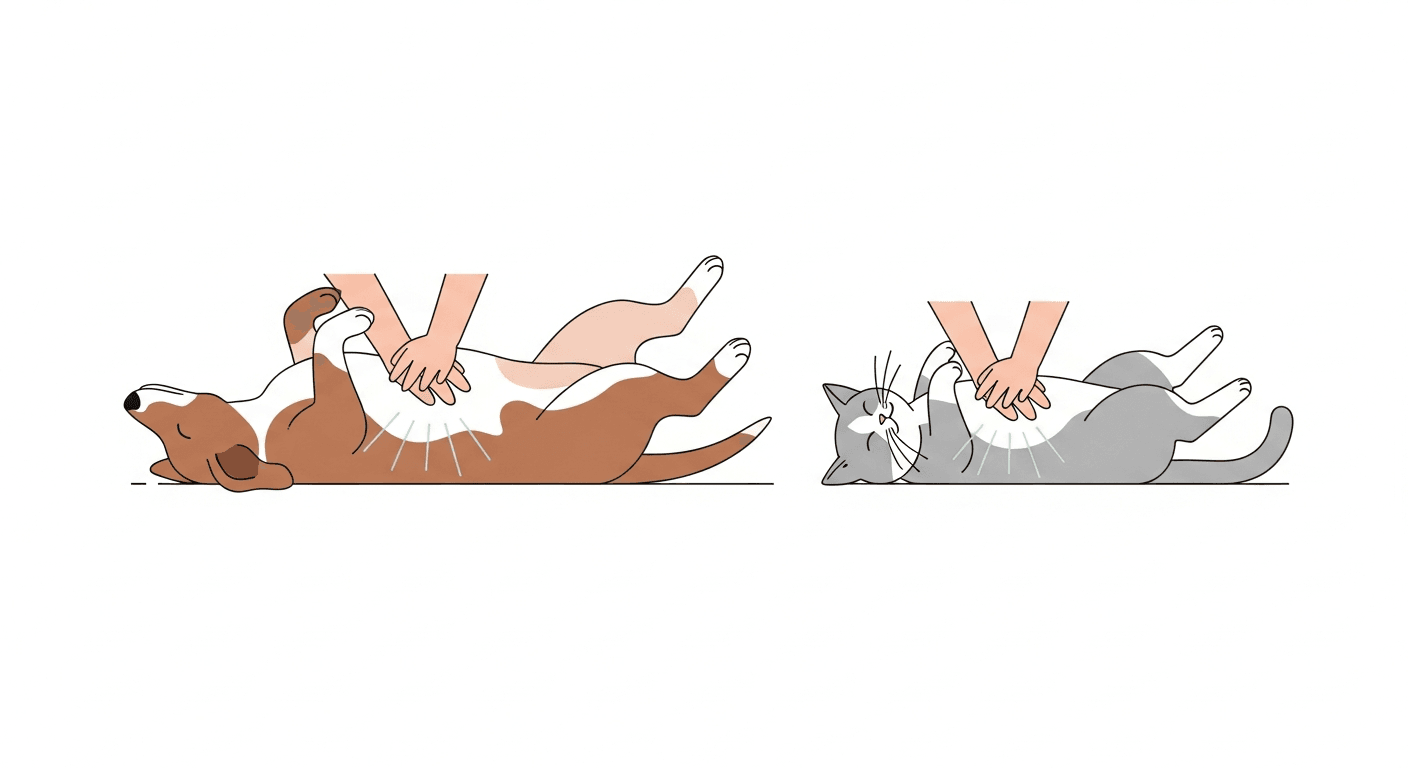
- Start CPR if the cat is unconscious and not breathing: Place the cat on its right side. Perform chest compressions at 100–120 per minute and provide rescue breaths every 30 compressions. See our full CPR guide for cats and dogs.
Immediate Care After Choking
Even if your cat recovers and seems normal within minutes, seek veterinary evaluation immediately. Throat trauma can cause swelling that worsens over 1–2 hours. There is also a risk of aspiration pneumonia if any material entered the airways. Your vet may take chest X-rays, check oxygen saturation, and prescribe medications to reduce airway inflammation.
Use TailRounds AI Triage to quickly assess what level of care your cat needs right now — it can guide you on whether to drive immediately or call ahead.
Dangerous Items to Keep Away From Cats
- String, thread, and yarn: Cats are irresistibly attracted to linear objects — these can be swallowed and cause both choking and gut obstruction
- Rubber bands and hair ties: Commonly swallowed and can become lodged
- Tinsel and ribbon: A holiday hazard every year
- Small toy parts and jingle bells: Often found inside cat toys that can break apart
- Bones from prey animals: Indoor-outdoor cats occasionally catch birds or rodents and choke on small bones
- Plastic bag handles and packaging ties: Leave these where cats cannot reach them
Book a Same-Day Vet Visit
Don't wait overnight after a choking episode. Cats hide discomfort extremely well, and a cat that seems fine may be developing internal swelling or aspiration injury. Book a vet appointment today, or use the clinic finder to locate an emergency practice if it's after hours. Your cat's airway health is not something to monitor from home — get eyes on it professionally.
Continue Reading
 🚑 First Aid
How to Perform CPR on a Dog or Cat: A Step-by-Step Guide
Learn pet CPR — how to check for pulse, perform chest compressions, and give rescue breaths for dogs and cats of different sizes, based on current guidelines.
 🚑 First Aid
Building a Pet First Aid Kit: Everything You Need and Why
The complete checklist for a home and travel pet first aid kit — what to include, what to avoid, and how to use the kit in a real emergency.
 🚑 First Aid
Cat Fallen from Height: How to Assess and Respond
Cats can survive remarkable falls but still need assessment. Learn what injuries to look for, how to handle a fallen cat safely, and when the vet is essential.
 🚑 First Aid
Eye Injury in Dogs and Cats: First Aid and When It's an Emergency
How to assess and respond to eye injuries in pets — scratches, foreign objects, prolapse, and chemical exposure — including safe flushing techniques.