
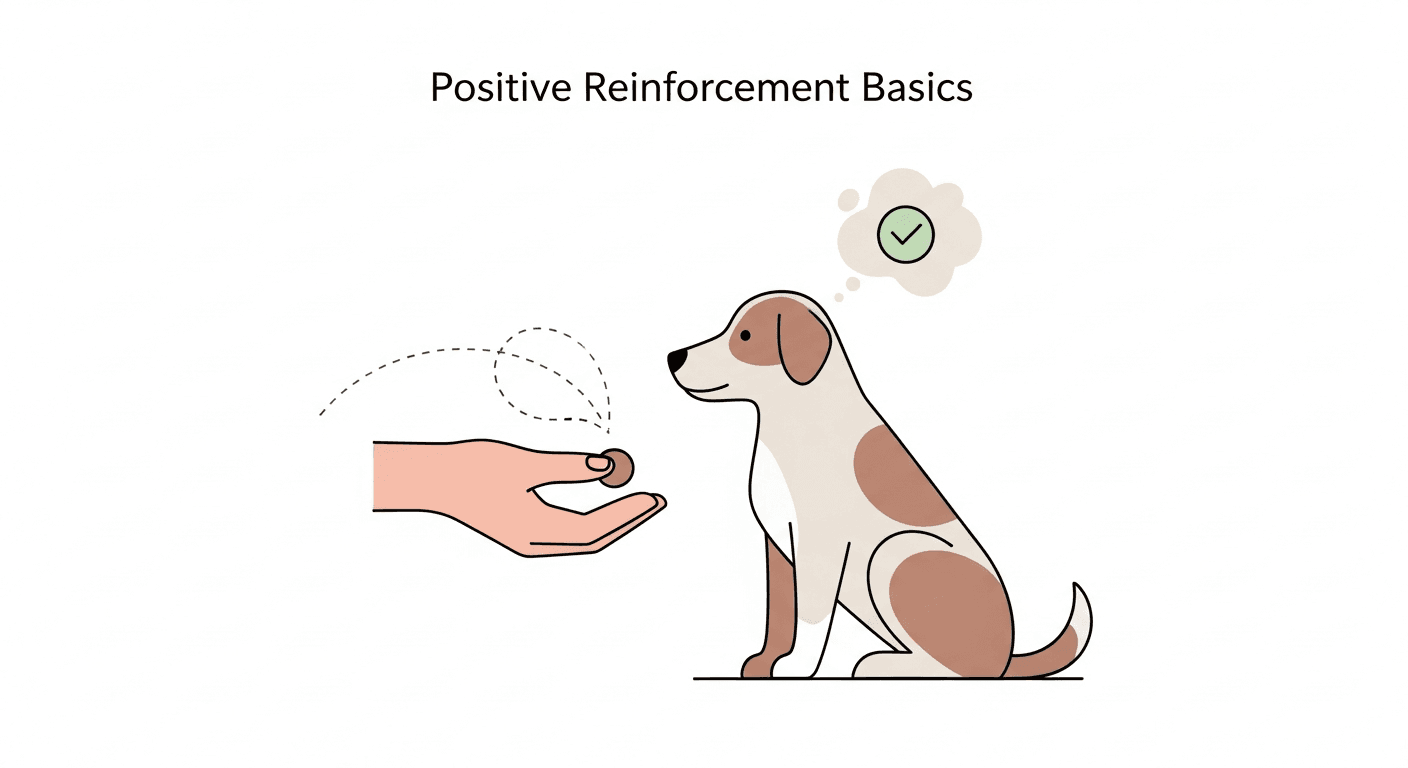
What Is Positive Reinforcement?
Positive reinforcement (R+) is the practice of adding something the learner values immediately after a desired behavior, making that behavior more likely to occur in the future. In dog training, this typically means giving a treat, praise, play, or access to something the dog wants the moment they do something you wanted them to do. The behavior increases in frequency because it reliably produces something good.
This is not simply "being nice to your dog" or bribery — it is the application of well-established principles from behavioral science (operant conditioning, developed by B.F. Skinner and refined by decades of animal learning research). The same principles that govern how all mammals learn are being applied systematically. Positive reinforcement is the primary training tool used by marine mammal trainers (you cannot use force or punishment on a dolphin), zoo animal behavior specialists, guide dog training programs, and competitive dog sport trainers at the highest levels.
Why R+ Outperforms Punishment-Based Methods
- Dogs trained with R+ learn faster: Numerous studies (including work by Blackwell, Casey, and colleagues published in peer-reviewed journals) show that dogs trained with reward-based methods learn more quickly and retain the behaviors longer.
- Fewer behavioral side effects: Punishment-based training carries significant risks of increasing anxiety, fear, and aggression — particularly redirected aggression. Reward-based training does not produce these side effects.
- Better dog-owner relationship: Dogs trained with R+ show more initiative, problem-solving, and engagement with their owner. Dogs trained with punishment tend to shut down and show fewer voluntary behaviors.
- Broader generalization: Dogs learn not just specific behaviors but a general optimistic, problem-solving approach to new challenges. "Try things and see what works" becomes the dog's default response to new situations.
- No risk of physical harm: Prong collars, choke chains, and shock devices all carry the risk of physical injury and can exacerbate anxiety and aggression.
The Four Quadrants of Operant Conditioning
Understanding the four quadrants helps clarify what "positive" and "negative" actually mean in behavioral science (not good/bad, but add/remove):
- Positive Reinforcement (R+): Add something good → behavior increases. (Treat after sit → more sitting)
- Negative Reinforcement (R-): Remove something aversive → behavior increases. (Release leash pressure when dog heels → more heeling)
- Positive Punishment (P+): Add something aversive → behavior decreases. (Shock when dog crosses boundary → less crossing) Carries significant risks.
- Negative Punishment (P-): Remove something good → behavior decreases. (Turn away when dog jumps → less jumping) Safe and effective.
Modern reward-based training primarily uses R+ and P-, avoiding aversive methods. This is sometimes called "Lima" (Least Intrusive, Minimally Aversive) training by professional organizations such as the IAABC.
How to Use Positive Reinforcement Effectively
- Timing is everything. The reward must arrive within one to two seconds of the desired behavior. Delays confuse the dog about what they are being rewarded for.
- Rate of reinforcement matters. When teaching something new, reward every single correct response. As the behavior becomes reliable, thin the schedule gradually (reward every other time, then randomly). Never thin too fast.
- Choose the right reward. Know your dog's hierarchy of reinforcers. For some dogs, a piece of chicken is worth ten kibbles. For some dogs, play with a ball is better than any food. Use the highest value reward the training situation demands — harder tasks need better rewards.
- Mark the moment. A marker (a clicker or a verbal "Yes!") tells the dog exactly which moment produced the reward. This precision dramatically speeds up learning, particularly for complex behaviors.
- Set the dog up to succeed. Management and setup should make the desired behavior highly likely. If the dog is failing more than 20% of the time, the task is too hard — break it into smaller steps.
- Be consistent. All family members should use the same cues, the same rewards, and the same rules. Inconsistency is one of the most common reasons R+ training stalls.
Common Myths About Positive Reinforcement
- Myth: "You will always need treats." Once a behavior is learned and proofed, you can maintain it with intermittent reinforcement and real-life rewards (walks, play, access to things the dog wants).
- Myth: "R+ only works for easy dogs." R+ is used successfully to train complex behaviors in wolves, large predators, and dogs with severe behavioral histories.
- Myth: "You need to establish dominance." The dominance theory of dog training is not supported by modern behavioral science. Dogs are not trying to dominate their owners — they are trying to get things they want using behaviors that have worked in the past.
Track your training sessions in the TailRounds Daily Log to monitor your dog's progress and identify which rewards work best. If you have questions about your training approach, use TailRounds AI Triage to get guidance or find a qualified trainer through Find a Clinic that partners with certified trainers.
Continue Reading
 🎾 Dog Training
Clicker Training for Dogs: A Complete Beginner's Guide
Learn how to use a clicker to train your dog faster and more precisely. Covers charging the clicker, timing, shaping, and fading the clicker.
 🎾 Dog Training
Teaching the Sit Command: A Step-by-Step Guide for Dogs
Learn how to teach your dog the sit command using positive reinforcement. Includes troubleshooting tips for stubborn or distracted dogs.
 🎾 Dog Training
Puppy Potty Training: A Complete Guide to House Training Success
A step-by-step potty training guide for puppies covering schedules, signals, accident handling, and common house training mistakes.
 🎾 Dog Training
Dog Training Tools Compared: What Works, What Harms, and What to Choose
An evidence-based comparison of popular dog training tools — from harnesses and clickers to prong collars and e-collars — and expert recommendations.