
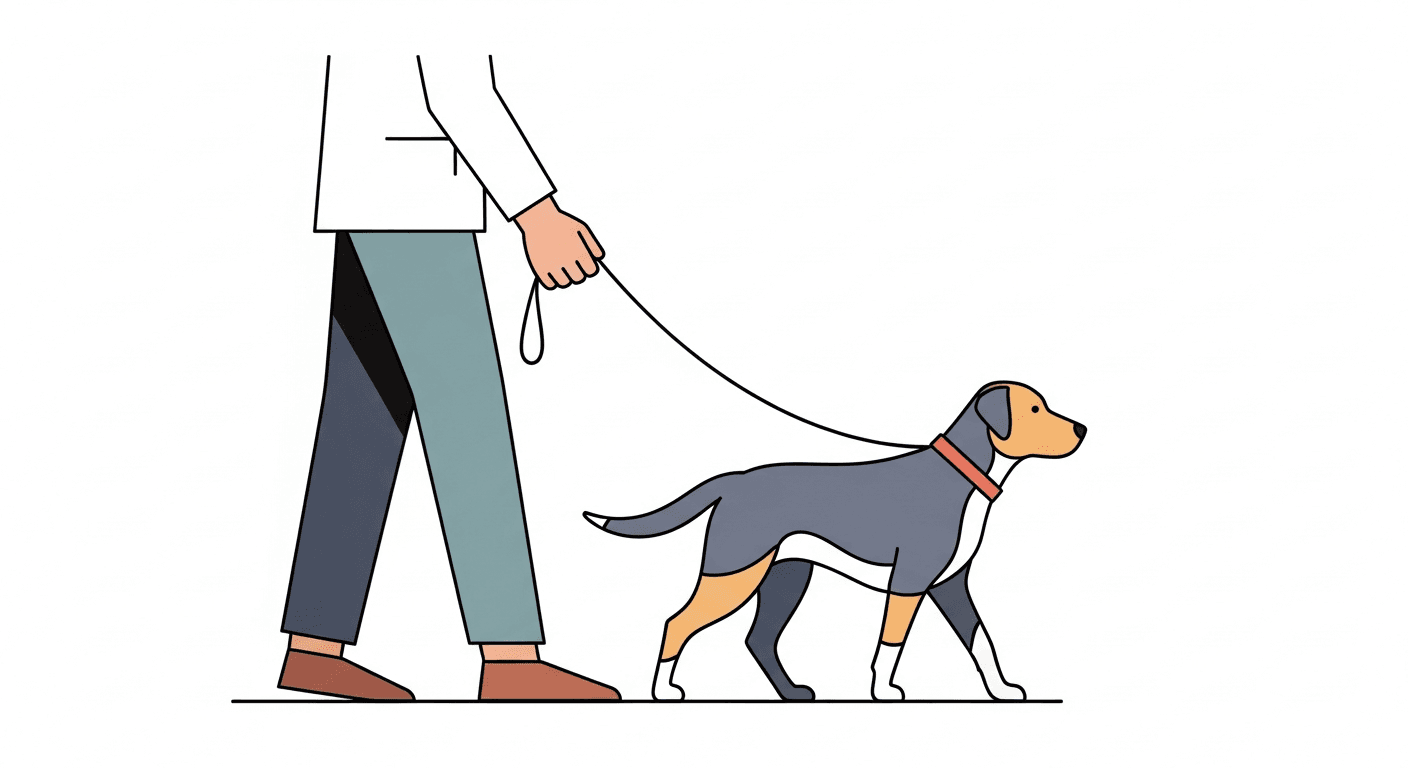
Heel vs. Loose Leash Walking: Understanding the Difference
Many dog owners use "heel" and "loose leash walking" interchangeably, but they are actually different skills with different practical applications. Understanding the distinction helps you train more effectively and use each skill where it is most useful.
Loose leash walking means the dog can walk anywhere within the length of the leash — ahead, beside, or slightly behind — as long as there is no tension on the leash. The dog has freedom to sniff, explore, and walk at their natural pace, as long as they are not pulling. This is what most people want for everyday walks.
Heel is a more formal, structured position in which the dog walks directly beside your left leg (traditionally) with their shoulder aligned with your hip. The dog must maintain this position through turns, stops, and changes of pace. Heel is used for navigating high-distraction situations, for competitive obedience, or when precise control is needed (crossing roads, passing other dogs).
Teaching the Heel Position
- Build the position first, without moving. Stand with your dog on your left side. Use a treat to lure your dog into position beside your left leg — shoulder level with your hip. Mark and reward for being in position.
- Name the position. Once your dog is reliably moving into position from a lure, add the cue "heel" as they arrive. Fade the lure to a hand signal (palm facing toward the dog, fingers pointing down) over many repetitions.
- Take one step. Say "heel," take one step forward, stop. If your dog is still in position, mark and reward. Repeat for five to ten steps, then gradually extend the number of steps before rewarding.
- Add turns. Practice left turns (which tend to keep the dog in position naturally as you move into them) and right turns (which require the dog to move faster to maintain position). Reward when they stay beside you through the turn.
- Add stops: Incorporate automatic sits — when you stop, your dog should automatically sit beside your left leg. Mark and reward every automatic sit.
- Vary pace: Speed up to a jog, slow down to an amble. The dog must adjust their pace to stay in position.
Teaching Loose Leash Walking
Loose leash walking is less structured but requires equally consistent training. The principle is simple: a tight leash stops all forward movement; a loose leash allows the walk to continue. Refer to our detailed guide on stopping leash pulling for the complete step-by-step method. The key additional elements for making loose leash walking reliable are:
- Reinforce check-ins: any time your dog voluntarily looks up at you during a walk, mark and reward. This builds the habit of the dog monitoring your position.
- Use a "penalty yard": if the dog pulls and you stop, wait for them to return to you rather than always waiting at the point where they stopped pulling. Make coming back to you feel rewarding.
- Vary your pace and direction unpredictably: dogs that have to pay attention to where you are going pull less than dogs walking in predictable straight lines.
Common Heel Training Problems
- Dog forges ahead: You are rewarding too far forward. Reward by placing the treat at your hip or behind it, so the dog must maintain a slightly back position to get the treat.
- Dog lags behind: Usually means the dog is unsure about the behavior or the training has been aversive in the past. Build speed and motivation by training in short, very fast-paced sessions and keeping energy high.
- Dog maintains position at home but not outside: Generalization is needed. Practice heel in multiple locations before expecting it to work in high-distraction environments. Add distractions gradually.
- Dog looks away from you in position: Build a "watch me" cue first, or use a treat held at your hip to keep attention.
Combining Heel and Loose Leash Walking in Real Walks
For most families, the most practical approach is to combine both skills strategically. Use a release cue like "free" or "go sniff" to release the dog from heel into loose leash walking mode for sniffing and exploring — then use the heel cue when you need precision (passing a dog, crossing a road, walking through a crowd). This combination gives your dog the enrichment of sniffing and exploring while giving you control when needed. Track how many times per walk you are using heel versus loose leash walking, and in which situations heel breaks down, using the TailRounds Daily Log. If your dog is still struggling significantly with leash manners after several weeks, consider a consultation with a certified trainer or ask for a referral at Happy Paws Veterinary Clinic.
Continue Reading
 🎾 Dog Training
How to Stop Leash Pulling: A Complete Training Guide
Practical methods to stop your dog pulling on the leash, covering loose-leash walking techniques, equipment choices, and common mistakes.
 🎾 Dog Training
Positive Reinforcement Training: The Science and How to Apply It
Understand how positive reinforcement works in dog training, why it outperforms punishment-based methods, and how to apply it effectively.
 🎾 Dog Training
Teaching the Sit Command: A Step-by-Step Guide for Dogs
Learn how to teach your dog the sit command using positive reinforcement. Includes troubleshooting tips for stubborn or distracted dogs.
 🎾 Dog Training
Dog Training Tools Compared: What Works, What Harms, and What to Choose
An evidence-based comparison of popular dog training tools — from harnesses and clickers to prong collars and e-collars — and expert recommendations.