
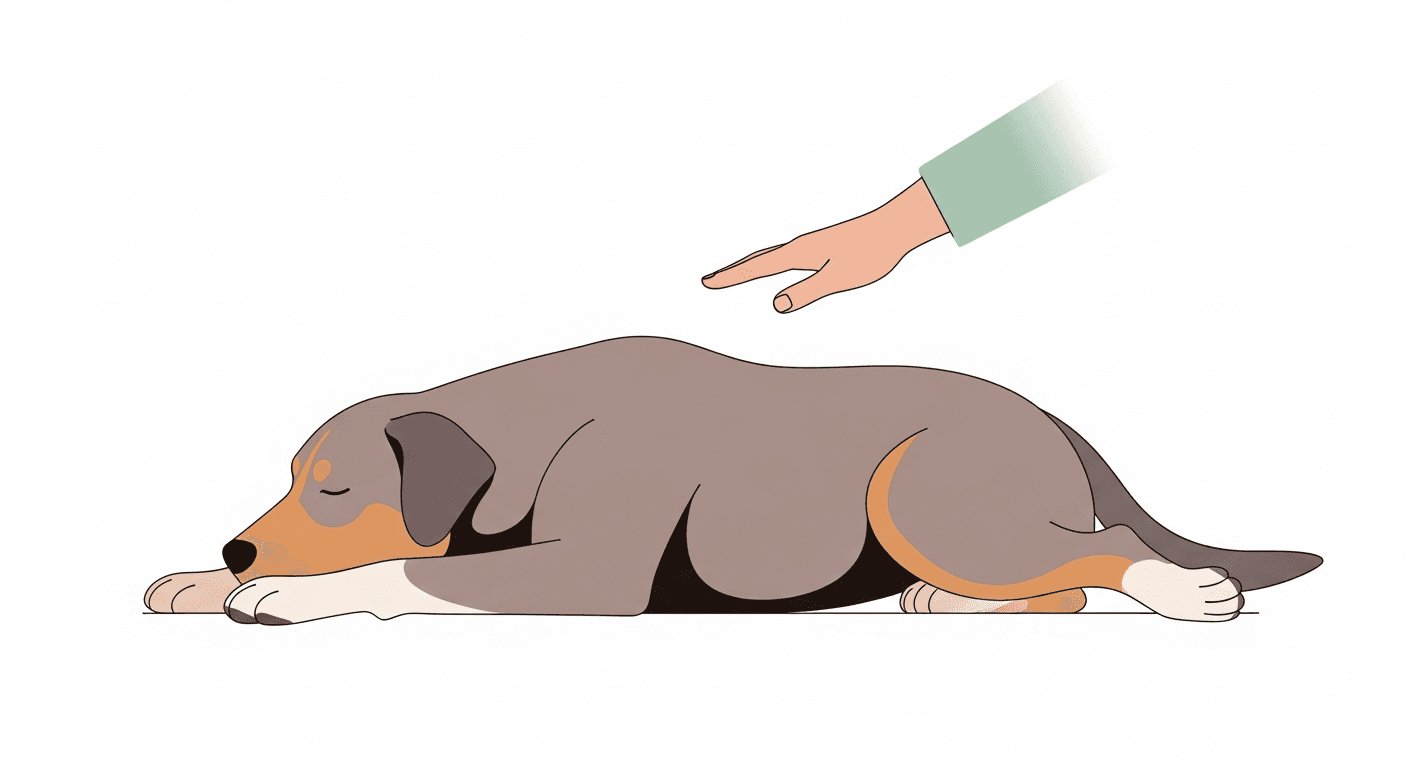
Why "Down" Is More Than Just a Trick
The down command is far more useful than it might appear. A dog in a down position is physically lower than in a sit, which tends to naturally reduce arousal and promote calmer energy. This makes "down" invaluable in practical situations: asking your dog to lie down and stay while you eat dinner, while guests visit, while at a café, or while you take a phone call. A down-stay is also harder to break than a sit-stay — it takes more physical effort to get up from a down, so dogs tend to hold the position longer and with less agitation.
For high-energy dogs or dogs that struggle to settle, the down command combined with a long stay is one of the most effective tools for teaching impulse control and calm behavior in real-world situations.
Method 1: Luring Into a Down
This is the most straightforward method and works well for most dogs.
- Start with your dog in a sit. Hold a treat at their nose.
- Slowly move the treat straight down toward the floor, between their front paws. As their nose follows the treat downward, their elbows should begin to lower toward the floor.
- Continue moving the treat along the floor away from the dog — this encourages the hindquarters to lower as well, completing the down.
- The moment all four elbows and haunches are on the floor, click or say "Yes!" and deliver the treat.
- Add the verbal cue "down" once the lure movement reliably produces the position, then gradually fade the lure to a hand signal.
Some dogs will go from sit to down smoothly. Others will stand up when you move the treat to the floor. If your dog keeps standing, try luring from a stand — some dogs find this more natural. Or try the next method.
Method 2: Shaping the Down
Shaping works well for dogs that have trouble following the lure into a down, or for dogs that understand clicker training well.
- Sit in a chair with your dog on the floor in front of you. Wait.
- Click and treat for any slight lowering of the head or bending of the elbows — any tiny movement toward a down.
- Raise your criterion gradually: only click for elbows touching the floor, then for full belly on the floor.
- Use a yoga mat or a specific spot on the floor to give the dog a clear target — some dogs find it easier to offer a down on a defined surface.
Method 3: Under the Leg Lure
Useful for dogs that know how to follow a lure but cannot quite get their hindquarters down. Sit in a chair and create a low tunnel with your knee. Lure your dog through the tunnel — they will naturally have to lower their body to pass under your leg, and many dogs drop into a down as they do so. Reward the down position. Over repetitions, remove the tunnel (straighten your leg) while still cueing the down.
Building Duration in the Down
A down that the dog immediately pops out of is not yet useful. Once the dog is reliably going into the down position, begin building duration exactly as you would for a stay:
- Ask for down. Reward after one second. Release.
- Gradually extend the time between asking for down and delivering the treat: three seconds, five, ten, thirty, sixty.
- Add a release word so the dog knows clearly when the down is over.
- Practice the down-stay with increasing distractions: people walking by, doorbell sounds, food being prepared nearby.
Teaching a "Settle": The Relaxed Down
Many trainers distinguish between a formal "down" (structured position held for a defined duration) and a "settle" (a more relaxed state where the dog lies down and simply rests calmly without a formal duration or position requirement). Teaching a settle is enormously valuable for dogs that are naturally hyperactive or struggle to self-regulate.
- Reward any spontaneous lying down during calm household moments
- Put a mat in your living room and reinforce your dog for going to it and lying down
- Practice settle in public: at outdoor café areas, waiting rooms, or parks
Log down-stay training progress in the TailRounds Daily Log, noting the duration and distraction level achieved in each session. If your dog is having trouble achieving any lying down position and you suspect stiffness or pain, consult your vet — difficulty lying down can be a sign of joint pain, particularly in older dogs. Use TailRounds AI Triage to assess whether physical discomfort may be contributing.
Continue Reading
 🎾 Dog Training
Teaching the Sit Command: A Step-by-Step Guide for Dogs
Learn how to teach your dog the sit command using positive reinforcement. Includes troubleshooting tips for stubborn or distracted dogs.
 🎾 Dog Training
Stay Command Training: Teaching Your Dog to Wait Patiently
A complete guide to teaching your dog a reliable stay command, covering duration, distance, and distraction proofing step by step.
 🎾 Dog Training
Positive Reinforcement Training: The Science and How to Apply It
Understand how positive reinforcement works in dog training, why it outperforms punishment-based methods, and how to apply it effectively.
 🎾 Dog Training
Clicker Training for Dogs: A Complete Beginner's Guide
Learn how to use a clicker to train your dog faster and more precisely. Covers charging the clicker, timing, shaping, and fading the clicker.