
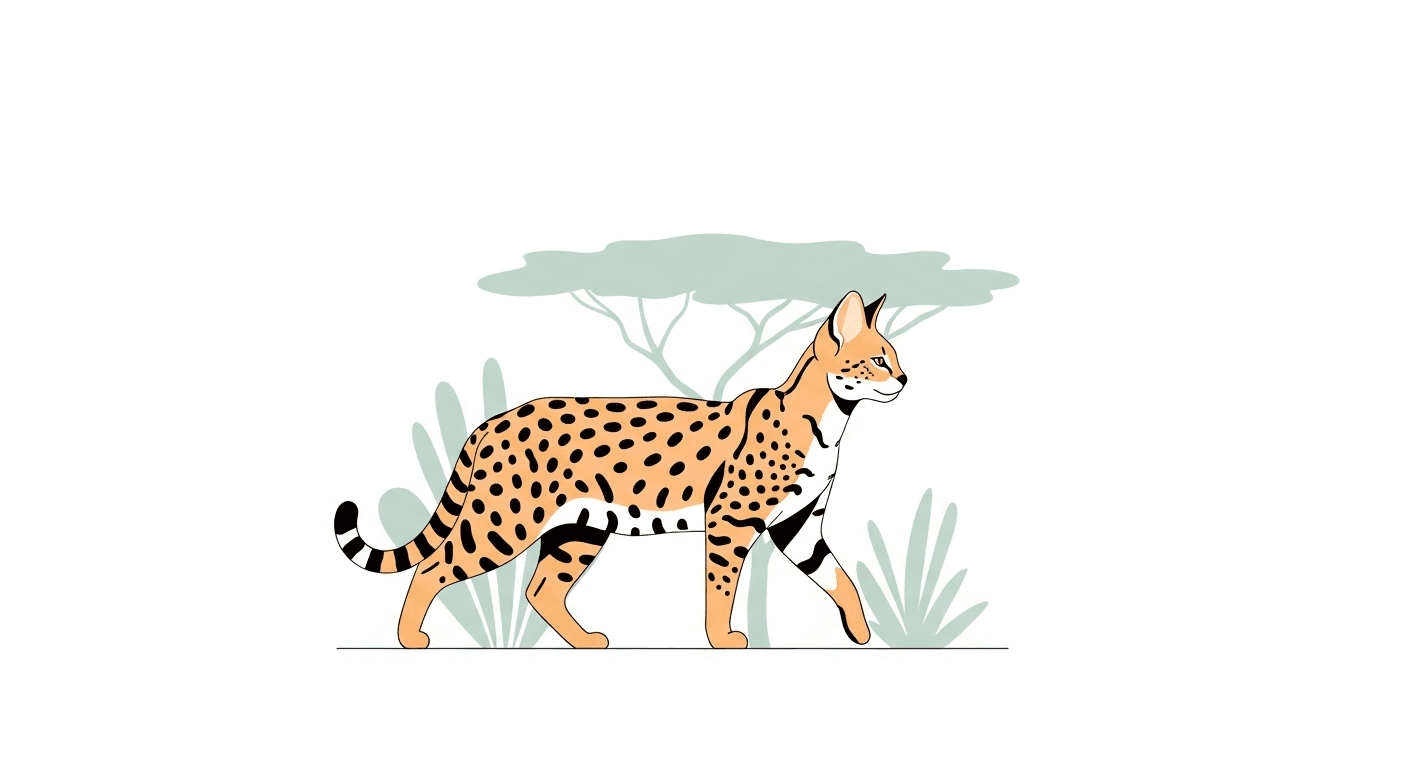
Savannah Cat Overview
The Savannah cat is the largest domestic cat breed in the world and one of the most exotic-looking. Created by crossing domestic cats with African Serval cats (Leptailurus serval), the Savannah is a tall, lean, spotted cat that resembles a miniature wild cat from the African savanna. The first Savannah kitten was born in 1986, and the breed was accepted by TICA in 2001. They are categorized by filial generation — F1 through F5+ — reflecting their proximity to the wild Serval ancestor.
F1 Savannah cats (first generation, direct Serval crosses) are the closest to wild and can be enormous — 17–25 pounds and extremely tall. F2 and F3 are progressively smaller and more domestic in behavior. By F4 and F5, Savannah cats are more predictably cat-like in behavior while retaining the exotic spotted appearance. The breed standard calls for a tall, long-legged body, large ears set on top of the head, a short thick tail, and a spotted or marbled coat pattern in brown, silver, black smoke, or black.
Personality and Temperament
Savannah cats are unlike any other domestic cat breed. Their temperament varies significantly by generation — F1 cats are far wilder and less predictable than F4+ cats, which behave similarly to highly active domestic breeds.
- Extraordinarily active: Savannah cats need far more physical and mental stimulation than typical domestic cats. They run, leap (F1s can jump 8 feet high from a standing position), and explore with intensity. Outdoor catios or large, safe outdoor enclosures are nearly essential for early-generation cats.
- Loyal and dog-like: Higher-generation Savannahs often greet owners at the door, follow them around the house, respond to their name, and can be leash-trained. Their loyalty to their family is remarkable.
- Wary of strangers: F1 and F2 Savannahs especially may be very cautious around unfamiliar people. Early and extensive socialization is essential.
- Water fascination: Like their Serval ancestors, Savannahs often love water — expect them to splash in water bowls, join you in the shower, or swim in shallow water.
- Not a lap cat: Most Savannahs are not cuddly cats. They prefer active engagement to passive affection.
- Extremely intelligent: They can open doors, understand complex puzzle feeders, and observe patterns in their environment. Mental stimulation is as critical as physical exercise.
The Savannah cat is not suitable for most households. They require exceptional commitment, space, enrichment, and experience with complex animal behavior. Early-generation cats (F1–F3) are generally recommended only for people with experience keeping wild or exotic animals.
Grooming Needs
The Savannah's short to medium-length coat is low-maintenance compared to many other breeds.
- Brushing: Once a week with a rubber grooming mitt or soft bristle brush is sufficient. Savannahs shed minimally.
- Bathing: Many Savannahs tolerate or enjoy baths due to their water affinity. Bathing every 4–6 weeks maintains coat condition.
- Nail trimming: Every 2–3 weeks. Savannahs have powerful claws — trimming is important for household safety as well as cat health.
- Dental care: Regular brushing and annual dental checkups are recommended. Raw diet advocates argue it supports dental health naturally.
Some Savannah owners feed raw or partially raw diets to more closely replicate their cats' ancestral nutrition. Always consult your veterinarian before switching to a raw diet to ensure safety and nutritional completeness.
Health Risks, Legal Status, and Common Conditions
Savannah cats are generally healthy, but their hybrid nature and size create unique health and legal considerations.
- Hypertrophic Cardiomyopathy (HCM): As with most cat breeds, annual cardiac monitoring is recommended.
- Anesthesia sensitivity: Hybrid cats can react differently to standard veterinary anesthetics. Always inform your vet that your cat is a Savannah before any procedure requiring sedation. Some vets have experience with hybrid cats; seek one out.
- Dental abnormalities: Savannahs can have unusual dentition including delayed or abnormal tooth eruption. Regular dental exams from kittenhood are important.
- Liver issues: Some early-generation Savannahs may not process certain medications normally due to differences in hepatic function. Discuss medication use with an exotic-animal-experienced vet.
- Legal restrictions: This is critical. Savannah cats — particularly F1, F2, and F3 generations — are banned or strictly regulated in many jurisdictions including Australia (all Savannahs banned), Georgia, Hawaii, Massachusetts, and other US states. Many countries require permits. ALWAYS verify local and national laws before acquiring a Savannah.
Savannah cats require vets with exotic animal experience. Book a vet appointment at Happy Paws to discuss your Savannah's unique health needs and ensure your vet team is prepared. Use the TailRounds Daily Log to track activity and behavioral patterns — key health indicators in a breed this active. Find a Clinic near you that has hybrid cat expertise.
Ideal Home, Cost, and Availability
Savannah cats are suited to highly experienced cat owners with substantial living space — ideally a large home with an outdoor catio or safely enclosed garden. They are not suitable for apartments without extraordinary enrichment, households with small children (for early generations), or first-time cat owners.
Purchase cost: F1 Savannahs: $10,000–$25,000+. F2 Savannahs: $4,000–$10,000. F3 Savannahs: $2,000–$5,000. F4–F6: $1,000–$3,000. The extraordinary cost reflects the difficulty and expense of Serval breeding programs.
Lifespan: 12–20 years. Higher-generation (F4+) Savannah cats tend toward the longer end of this range, particularly with diligent preventive care.
Continue Reading
 🐈 Cat Breeds
Bengal Cat: Complete Breed Guide — Personality, Activity & Health
Everything about Bengal cats: their wild look, high energy needs, unique coat, health risks including HCM and PRA, and whether this exotic breed is right for your home.
 🐈 Cat Breeds
Abyssinian Cat: Complete Breed Guide — Personality, Care & Health
A full guide to the Abyssinian cat: its athletic personality, ticked coat, moderate grooming needs, health risks including PRA and renal amyloidosis, and ideal home.
 🐈 Cat Breeds
Oriental Shorthair: Complete Breed Guide — Personality, Care & Health
A full guide to the Oriental Shorthair: its dramatic appearance, extraordinary range of colors, Siamese-like personality, health risks, and why this breed is not for the faint of heart.