
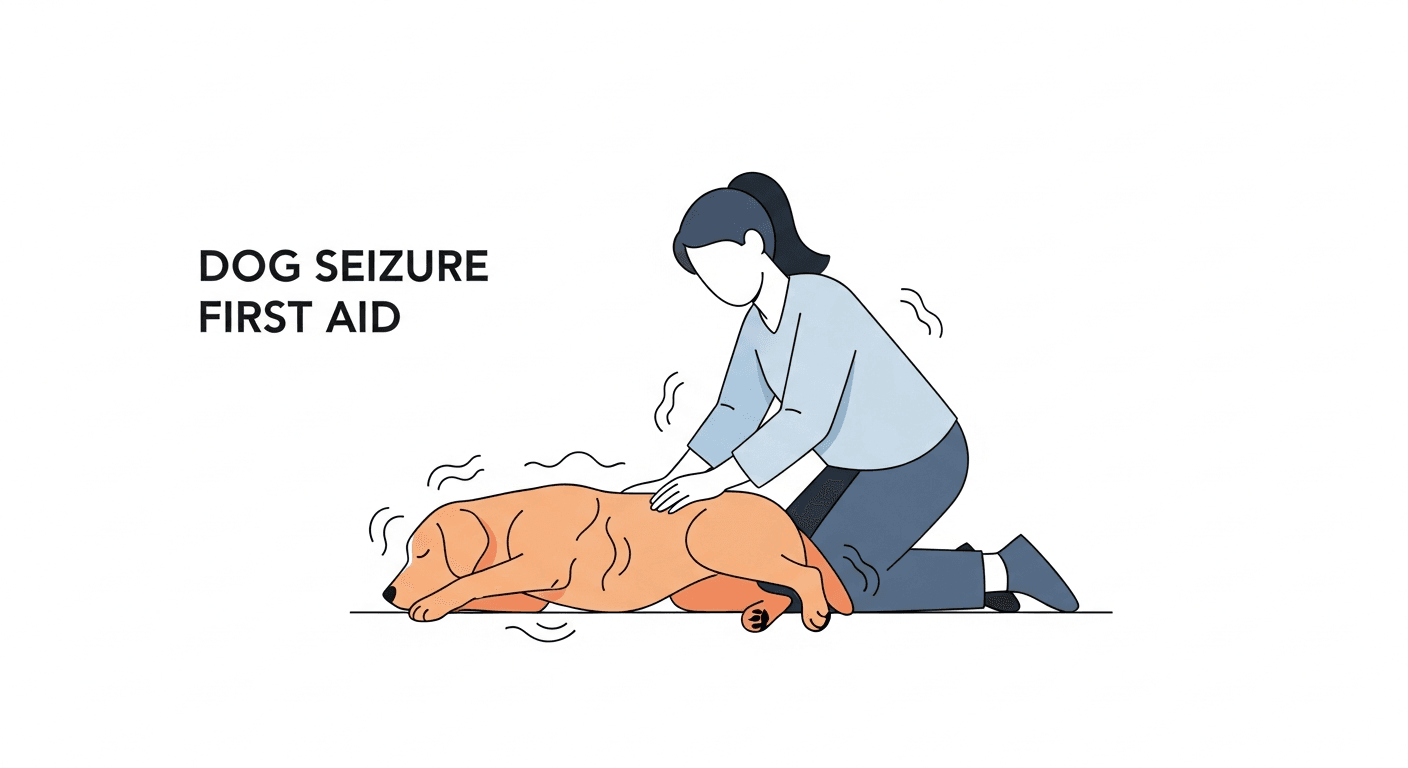
What Is a Dog Seizure?
A seizure is a sudden, uncontrolled electrical disturbance in the brain that causes involuntary muscle movement, altered consciousness, and abnormal behavior. In dogs, the most common type is a generalized tonic-clonic seizure: your dog suddenly falls on their side, becomes rigid, then paddles their legs involuntarily, may lose bladder or bowel control, and is completely unresponsive for 30 seconds to 2 minutes. A post-ictal phase follows — the dog seems confused, wobbly, blind, or disoriented for minutes to hours after. Seizures can be caused by epilepsy, toxins, low blood sugar, liver disease, brain tumors, and many other conditions.
First 3 Steps You Can Take at Home
- Stay calm and keep your dog safe: Your instinct will be to comfort your dog, but during a seizure they are unconscious and don't experience fear — you do. Move furniture and sharp objects away from your seizing dog. Do NOT put your hands near their mouth — dogs do not swallow their tongues, and a seizing dog can bite severely without intending to. Place a cushion or folded blanket under their head to prevent head injury if they're on a hard floor. Time the seizure from the moment it starts.
- Record the seizure if possible: A 30-second video on your phone is incredibly valuable for your vet. If you can safely do so without putting yourself at risk, record what the dog looks like during and immediately after the seizure. This helps your vet classify the type of seizure and assess severity far better than a verbal description alone.
- Monitor the post-ictal phase: After the seizure ends, your dog may seem wobbly, confused, temporarily blind, or unusually hungry or thirsty. This post-ictal phase is normal and typically lasts 5–30 minutes. Keep your dog calm in a quiet, dimly lit space. Don't let them near stairs or water. Offer water once they're steady. Contact your vet even if the seizure was brief — a first seizure always requires evaluation.
When to Go to the Vet Immediately
- Seizure lasts more than 3–5 minutes (status epilepticus — life-threatening emergency)
- More than 2 seizures in a 24-hour period (cluster seizures)
- Dog doesn't recover fully within 30 minutes after the seizure
- This is your dog's first ever seizure
- Suspected toxin ingestion before the seizure
Follow-Up Care Checklist
- ☐ Record date, time, and duration of every seizure
- ☐ Note what happened in the hour before each seizure (activity, food, environment)
- ☐ If on anti-epileptic medication, never skip or change doses without vet guidance
- ☐ Blood levels for medications like phenobarbital need periodic monitoring
- ☐ Seizure diary (date, duration, severity, post-ictal time) is essential for medication management
- ☐ Know your nearest emergency vet's number and location before another seizure occurs
📋 Log This With TailRounds
A seizure diary in the TailRounds daily log is one of the most important tools for managing epileptic dogs. Frequency, duration, and triggers all help your vet fine-tune medication to keep seizures controlled.
Start Free →Book a Vet Appointment
Any dog that has had a seizure needs a veterinary evaluation — even a brief one that resolved quickly. Blood work, neurological exam, and possibly MRI or CSF analysis may be recommended to identify the cause and guide treatment. Book an appointment at Happy Paws Veterinary Clinic — same-week slots are usually available.
Summary for Your Clinic
Pet concern: Dog Seizure
Seizure description: [duration, full body or focal], post-ictal recovery time
Number of seizures: [first ever / recurring], frequency if recurring
Possible triggers: [toxin/activity/stress/unknown]
Questions for vet: What tests do we need? Should we start anti-epileptic medication? What are the emergency triggers for the ER?
Related Articles
Continue Reading
 🐕 Dog Health
Dog Shaking and Trembling: When Is It Serious?
From cold to pain to toxins — why dogs shake and tremble, and how to know when it's a medical emergency vs. normal behavior.
 🦴 Dog Care
Dog Collapse Emergency Checklist
What to do when your dog suddenly collapses — the immediate steps to take, what to check, and how to get help quickly.
 🦴 Dog Care
Dog Medication Guide for Pet Owners
How to give your dog medication safely, common medication types, what to watch for, and which human medications are dangerous for dogs.